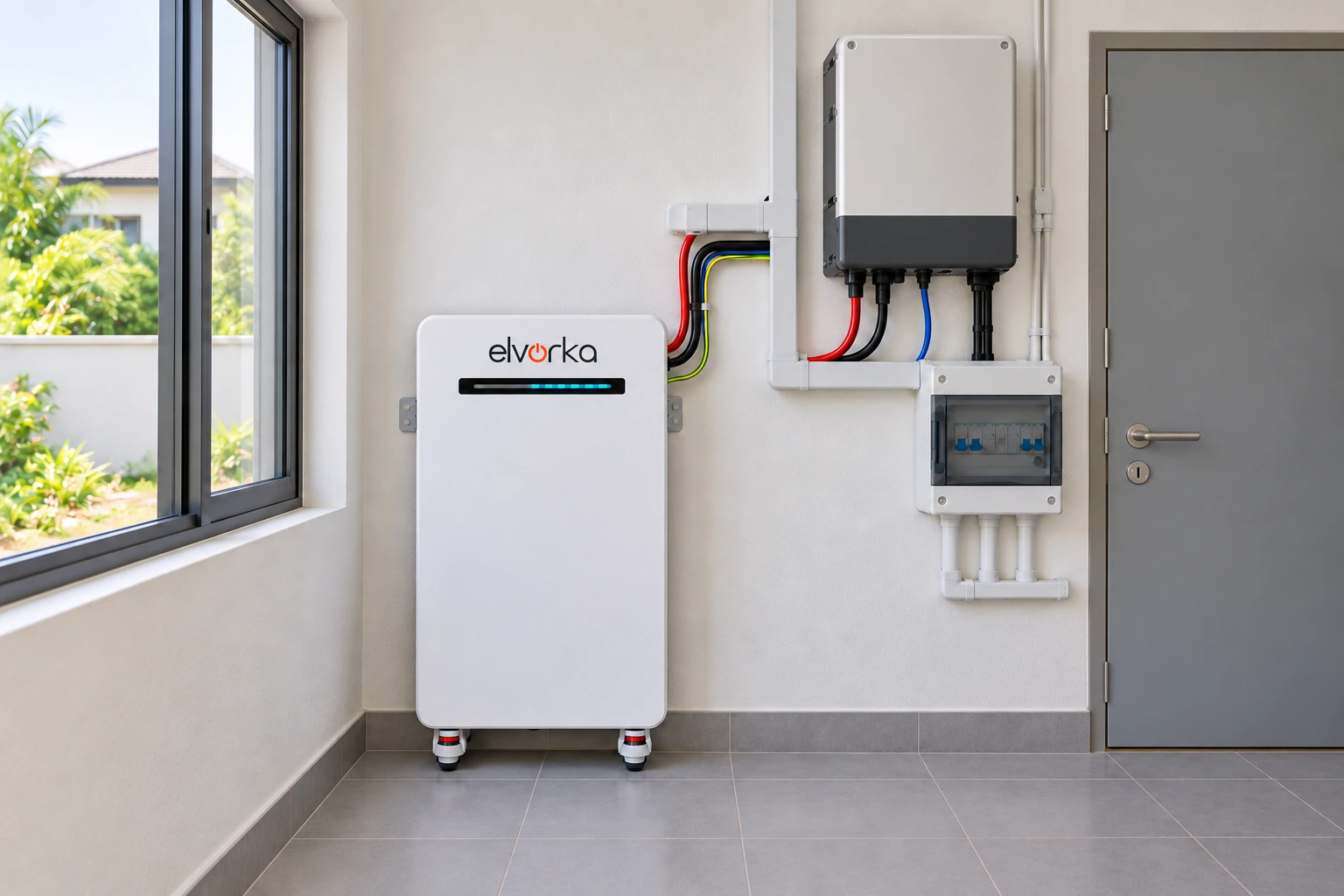
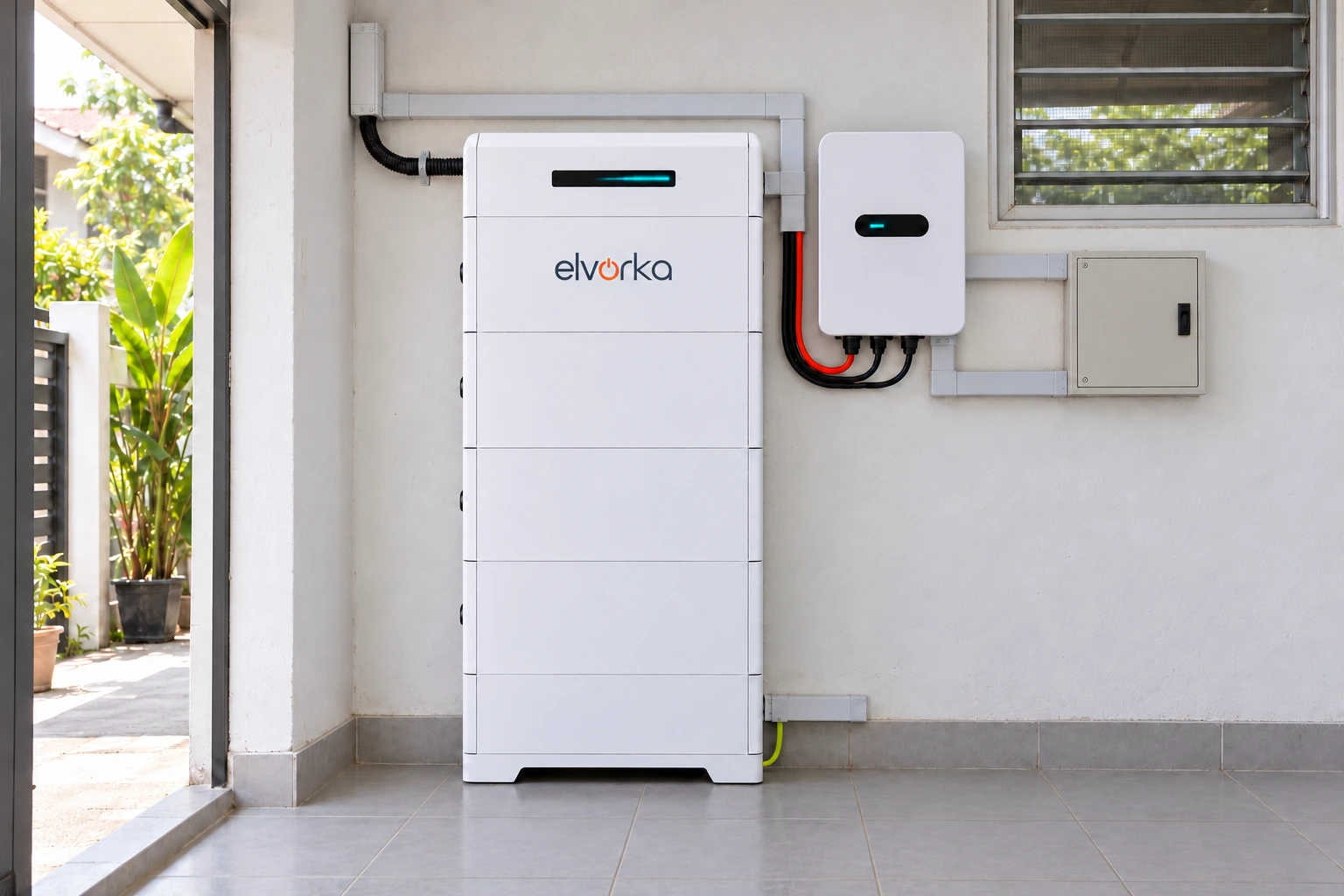
A dry utility room, a seasonally hot garage and a coastal service area place different demands on equipment. Assess conditions where the battery will stand, including the coldest and hottest periods. The following local profiles help frame the questions; they do not certify a particular installation.
Keep evening essentials and home-office equipment in your backup plan. From an enclosed terrace-house utility room to a protected coastal service space, choose the storage format around your home, its heat and moisture exposure, and the inverter you use.
Battery storage for tropical homes.
Dry terrace-house utility room
For a new system in a dry enclosed room beside the car porch, one cabinet brings the battery and inverter together and keeps the equipment layout straightforward.
EU 230 V offers integrated battery storage with 6.2 or 12 kW rated AC configurations and an IP21 housing. Allow the model-specific cooling and service space, and select the configuration around your essential circuits.
Questions for your installer
- What is the hottest expected temperature inside this room?
- Are the vents and service sides clear of parked vehicles, cupboards and stored items?
Protected storage for a coastal home
A sheltered equipment space gives coastal homes a place to organise storage and its connections. METMalaysia identifies stronger northeast-monsoon rain exposure in eastern Peninsular Malaysia, western Sarawak and northeastern Sabah.
Compare the compact TR Pro battery and the expandable HP Ultra stack, both listed with IP66 enclosures. Use the room and enclosure together in the design; rain, condensation and coastal exposure still need model-specific review.
Questions for your installer
- Can wind-driven rain, wash water or standing water reach this location?
- Is the site exposed to coastal air or condensation, and what protection does the exact model require?
Existing inverter in a compact service area
Add energy capacity while retaining an existing inverter where compatibility is established. Wall-mounted and modular formats give different ways to use a dedicated service area.
TR Pro is a 51.2 V battery family; HP Ultra is high voltage. Match the inverter's battery-voltage window, CAN/RS485 support and charge/discharge settings. Do not substitute a high-voltage stack for a low-voltage battery connection.
Questions for your installer
- What are the inverter make, model and supported battery-voltage range?
- Is there room for the battery, mechanical fixing and separate protected power/communication routes?
Planning notes
- TR Pro lists charging at 0 to 55 °C and discharging at −20 to 60 °C. EU 230 V lists charging at 0 to 55 °C and discharging at −20 to 55 °C. Check room temperature and any model-specific derating; do not assume constant output across the entire range.
- IP66 on TR Pro/HP Ultra is not a blanket approval for any outdoor position. TR standard and HP K list IP20 with IP54 optional, TB rack lists IP20, and EU lists IP21. Verify the exact housing option and installation manual.
- Use kWh to plan duration and kW to check the load. If air-conditioning or a pump is required, provide its actual running and starting requirements rather than adding it to a basic preset without review.
Keep charging and discharging limits separate
The TR Pro literature lists charging at 0–55 °C and discharging at −20–60 °C. The colder discharge boundary is not permission to charge below zero. Self-heating is optional and must be confirmed for the exact configuration. HP Ultra temperature limits require configuration confirmation; do not transfer another family's limits to it.
Read the views, then request the exact manual
The technical library retains the original product views and numbered interface labels. A visible connector is not enough to infer a pinout, polarity or power rating. Confirm the selected model's wiring diagram, protection, cable requirements, clearances, torque values and communication settings from its installation documentation. The scene illustrations are visual references, not wiring instructions.
Record the proposed room, expected temperatures, moisture exposure and maintenance access. For an integrated system, confirm the required AC configuration. For a battery-only system, include the existing inverter model and DC voltage range in the brief.
Questions for your installer
Does IP66 make any outdoor position suitable?
No. IP66 does not by itself establish protection against flooding, condensation or coastal corrosion. Confirm the exact battery version, shelter, mounting, drainage and service clearances with the installer.
Can the basic examples include air-conditioning?
The examples exclude air-conditioning. Provide the appliance's operating load, start-up demand and expected operating time, then confirm both battery energy and inverter output for the proposed system.
Can I add a battery to any existing inverter?
No. Confirm the inverter model, supported battery-voltage range, current limits, communication protocol and settings. A 51.2 V battery and a high-voltage modular stack are different system choices.